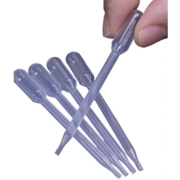

The transfer pipette is one of the most frequently used — and most frequently underestimated — tools in any laboratory. It's cheap, disposable, and requires zero training. But that simplicity hides a surprising range of applications, from routine reagent handling to precision point-of-care blood diagnostics.
This guide covers everything you need to know about transfer pipettes: how they work, the types available, and where they fit in modern laboratory workflows.
How a Transfer Pipette Works
A transfer pipette operates on a simple air-displacement principle. The integrated squeeze bulb acts as both the pump and the reservoir. When you compress the bulb with your fingers, air is expelled through the narrow tube. Submerge the tip in liquid, release the bulb, and the returning air pressure draws liquid into the barrel.
To dispense, simply squeeze the bulb again. The single-piece construction means there are no valves, seals, or moving parts to fail or contaminate — which is why transfer pipettes are one of the most reliable liquid-handling tools in existence.
Types of Transfer Pipettes
Not all transfer pipettes are the same. Here are the main categories:
Standard Transfer Pipettes
The classic one-piece LDPE pipette with graduated or non-graduated barrels. Volumes typically range from 0.5 to 10 mL. These are the everyday workhorse for routine laboratory liquid transfers — adding reagents, moving samples, dispensing wash buffers.
Fixed-Volume Transfer Pipettes
Pre-calibrated to deliver exactly one specific volume (e.g., 50 µL, 100 µL, 200 µL, 500 µL) with ±0.5–1.5% accuracy. The color-coded cap system allows instant volume identification. These are used when you need disposable precision without the cost of a mechanical pipettor.
Capillary Pipettes
Ultra-thin tubes that use capillary action — not air displacement — to draw micro-volumes of blood or liquid (2–50 µL). Widely used in hematology analyzers, CRP testing, PCT assays, and any application where you need a precise micro-sample from a finger prick.
Blood Collection Devices
Integrated devices that combine a capillary pipette with a pre-filled diluent chamber. One touch draws the blood sample, and pushing the capillary into the mixing chamber prepares it for immediate POCT analysis. These are revolutionizing point-of-care diagnostics by reducing sampling time to under 2 seconds.
Applications Across Industries
Clinical Diagnostics
Transfer pipettes are essential in clinical labs for handling blood, urine, and serum samples. Sterile individually-wrapped pipettes prevent cross-contamination during sample preparation. Fixed-volume and capillary versions enable precise micro-sampling for rapid diagnostic tests.
Pharmaceutical Research
In pharmaceutical labs, transfer pipettes are used for reagent addition, sample preparation, and formulation testing. The chemical resistance of medical-grade LDPE makes them compatible with most pharmaceutical solvents and reagents.
Environmental Testing
Water quality labs use transfer pipettes for sample handling, reagent dispensing, and preparation of test solutions. The disposable nature eliminates the risk of carryover contamination between samples from different collection sites.
Food & Beverage Quality Control
Food science labs use food-grade transfer pipettes for ingredient measurement, contaminant testing, and quality control sampling. The fact that they're disposable and certified food-safe makes them ideal for environments where cross-contamination could affect product safety.
Education
Teaching labs at all levels use transfer pipettes because they're safe, inexpensive, and don't require technical training. Students can focus on learning experimental concepts without worrying about breaking expensive glass equipment.
What to Look for When Buying Transfer Pipettes
- Material: Medical-grade LDPE or PP for chemical resistance and clarity
- Sterility: Gamma-irradiated individual wrap for clinical and biological work
- Accuracy: Graduated vs non-graduated vs fixed-volume depending on your precision needs
- Certifications: ISO 9001 and ISO 13485 for consistent manufacturing quality
- Customization: OEM printing, packaging, and tip design options for your specific workflow
- Pricing: Factory-direct pricing with flexible MOQs for cost optimization
Explore Our Full Product Range
Summary
The transfer pipette may be the simplest tool on your lab bench, but it's also one of the most versatile. From basic reagent transfers to precision POCT blood sampling, the right transfer pipette — selected for the right application — can improve your lab's efficiency, reduce contamination risk, and lower consumable costs.
Whether you need standard bulk pipettes, sterile individually-wrapped units, or custom-designed fixed-volume devices, working with an ISO-certified manufacturer ensures you get consistent quality at every scale.
Need Transfer Pipettes for Your Lab?
We manufacture precision transfer pipettes, serological pipettes, and POCT blood collection devices, with OEM customization, flexible MOQs, and ISO 13485 certification.