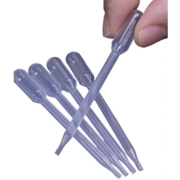

Walk into any lab, and you'll find both transfer pipettes and serological pipettes on the bench. They look similar — both are tube-shaped, both move liquids — but they serve fundamentally different purposes. Using the wrong one can mean blown experiments, contaminated samples, or simply wasted time.
This guide breaks down exactly how these two pipette types differ, where each one excels, and how to decide which one belongs in your next order.
What Is a Transfer Pipette?
A transfer pipette (also called a Pasteur pipette or dropper) is a single-piece plastic tool with an integrated squeeze bulb. You compress the bulb, dip the tip into your liquid, release — and the liquid draws up. Squeeze again to dispense. No controllers, no calibration, no training required.
Transfer pipettes are typically made from LDPE (Low-Density Polyethylene), come in volumes from 0.5 mL to 10 mL, and are designed for one-time use. Most labs use non-graduated versions for rough transfers, though graduated models offer approximate volume markings with ±10–15% accuracy.
What Is a Serological Pipette?
A serological pipette is a precision-graduated cylindrical tube — usually made from polystyrene or glass — with fine volume markings along its entire length. Unlike transfer pipettes, serological pipettes require a pipette controller (manual or electronic) to aspirate and dispense liquids.
They typically range from 1 mL to 50 mL, feature color-coded size bands for quick identification, and meet ISO 835 accuracy standards. Many are "blow-out" pipettes, meaning you must fully expel the last drop to achieve the marked volume.
Key Differences at a Glance
- Accuracy: Transfer pipettes offer ±10–15% approximate volume. Serological pipettes provide ±1–2% calibrated precision.
- Operation: Transfer pipettes are self-contained (built-in bulb). Serological pipettes need an external pipette controller.
- Volume Range: Transfer pipettes cover 0.5–10 mL. Serological pipettes cover 1–50 mL.
- Material: Transfer pipettes are LDPE plastic. Serological pipettes are polystyrene or glass.
- Cost: Transfer pipettes cost $0.02–0.10 each. Serological pipettes cost $0.30–1.50 each (plus the controller).
- Sterility: Both are available sterile. Transfer pipettes are individually wrapped; serological pipettes come in sterile peel-pack sleeves.
- Reusability: Transfer pipettes are single-use. Glass serological pipettes can be autoclaved and reused.
When to Use Transfer Pipettes
Transfer pipettes are ideal when speed and convenience matter more than volumetric precision. Common use cases include:
- Adding reagents to test tubes or reaction vessels
- Transferring samples between containers during routine labwork
- Layering liquids in density gradient experiments
- Dispensing stains, indicators, or wash buffers
- Point-of-care diagnostics (blood, urine sample handling)
- Educational and teaching lab environments
If your protocol doesn't specify a volume tolerance tighter than ±15%, a transfer pipette is almost always the faster, cheaper choice.
When to Use Serological Pipettes
Serological pipettes are the right choice when accuracy is non-negotiable. They're essential for:
- Cell culture media preparation and cell seeding
- Serial dilutions requiring documented precision
- Titration and analytical chemistry procedures
- Reagent preparation in pharmaceutical manufacturing
- Clinical testing with regulatory volume requirements
- Any protocol specifying a volume tolerance of ±5% or tighter
Can You Use One Instead of the Other?
In practice, many labs use both types daily. The mistake is reaching for a transfer pipette when your protocol demands calibrated volumes — or wasting expensive serological pipettes on tasks that only need a rough transfer.
A simple rule of thumb: if the volume matters to your result, use a serological pipette. If you're just moving liquid from point A to point B, a transfer pipette gets it done in half the time at a fraction of the cost.
Choosing a Reliable Supplier
Whether you need transfer pipettes or serological pipettes, quality consistency matters. Look for manufacturers who hold ISO 13485 certification, offer sterile and non-sterile options, and can provide OEM customization for your specific lab workflow. Bulk pricing and flexible MOQs are critical for keeping consumable costs under control.
Explore Our Product Lines
The Bottom Line
Transfer pipettes and serological pipettes aren't interchangeable — they're complementary. Transfer pipettes give you speed and cost-efficiency for routine work. Serological pipettes give you precision and compliance for critical procedures. Understanding when to use each one keeps your lab running efficiently without overspending on consumables.
Need Transfer Pipettes for Your Lab?
We manufacture precision transfer pipettes, serological pipettes, and POCT blood collection devices, with OEM customization, flexible MOQs, and ISO 13485 certification.