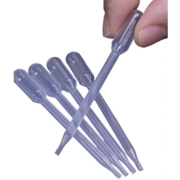

Ordering transfer pipettes seems simple — pick a size, check a box, done. But the wrong choice shows up fast: collapsed barrels that won't hold liquid, tips that are too wide for your test tubes, or non-sterile pipettes contaminating your cell cultures.
This guide covers the five factors that actually matter when selecting transfer pipettes, so you can match the right pipette to your application without overpaying or under-specifying.
1. Match the Volume to Your Application
Transfer pipettes typically come in 0.5 mL, 1 mL, 3 mL, 5 mL, 7 mL, and 10 mL sizes. The most common mistake is choosing a pipette that's too large for the job — an oversized bulb reduces your control over drop size and increases the risk of over-dispensing.
- Micro-volumes (50–500 µL): Use fixed-volume transfer pipettes with pre-calibrated delivery. These are designed for POCT diagnostics and precision sampling.
- Small volumes (0.5–1 mL): Best for adding indicators, stains, and small reagent volumes to test tubes.
- Medium volumes (3–5 mL): The general-purpose workhorse for most lab transfers.
- Large volumes (7–10 mL): For moving larger sample volumes or filling cuvettes and reaction vessels.
Rule of thumb: choose the smallest pipette that comfortably handles your target volume. You'll get better control and less waste.
2. Graduated vs Non-Graduated
Graduated transfer pipettes have printed volume markings along the barrel. These are useful when you need approximate volume measurement (±10–15%) without switching to a calibrated instrument. Non-graduated pipettes are cheaper and fine when you don't need any volume indication.
Important: graduated pipettes are NOT a substitute for calibrated serological pipettes. If your protocol specifies "±5% accuracy" or tighter, you need a different tool.
3. Material Quality — What to Look For
Most transfer pipettes are made from LDPE (Low-Density Polyethylene). But quality varies dramatically between manufacturers. Here's how to tell good LDPE from bad:
- Clarity: The barrel should be clear and transparent, not cloudy or hazy. Cloudy plastic indicates recycled or impure material.
- Wall uniformity: Squeeze the bulb — it should return to its original shape instantly. Barrels that collapse or crinkle indicate thin, inconsistent walls.
- Tip cut: The tip opening should be clean and centered, not ragged or off-angle. A bad tip cut affects drop consistency.
- Chemical resistance: Medical-grade LDPE resists most common lab chemicals. Verify compatibility if you're working with organic solvents.
4. Sterile or Non-Sterile?
This decision is straightforward: if your application involves biological samples, cell cultures, clinical diagnostics, or anything where contamination would invalidate results — choose sterile, individually wrapped pipettes.
Sterile pipettes are gamma-irradiated and sealed in individual packaging. Non-sterile pipettes come in bulk bags and are fine for general-purpose chemistry, teaching labs, and non-critical transfers.
Pro tip: don't buy sterile pipettes "just in case" if you only do general chemistry. The price premium is 2–3x, and the individual wrapping slows down your workflow.
5. Tip Design and Special Features
Beyond the basics, some applications require specialized tip designs:
- Fine-tip pipettes: Narrower opening for more controlled drop delivery. Useful for microscopy and delicate sample loading.
- Wide-bore pipettes: Larger opening that won't shear cells or clog with particulates. Essential for cell culture and viscous liquids.
- Extended-tip pipettes: Longer barrels that reach into narrow-neck containers and centrifuge tubes.
- Blood-draw capillary pipettes: Integrated capillary action for finger-prick diagnostics (CRP, PCT, HbA1c testing).
Evaluating Suppliers: What to Ask
When comparing transfer pipette suppliers, these questions separate serious manufacturers from resellers:
- What are your ISO certifications? (Look for ISO 9001 and ISO 13485 for medical devices.)
- Can you provide a Certificate of Analysis for each lot?
- What is your minimum order quantity (MOQ)? Flexible MOQs matter for smaller labs.
- Do you offer OEM customization — custom printing, packaging, and branding?
- What is your production capacity and lead time?
- Can you provide reference customers in my market?
Browse by Category
Making Your Decision
The right transfer pipette isn't the cheapest or the most expensive — it's the one that matches your application's volume, accuracy, sterility, and material requirements without adding unnecessary cost. Start by defining what your protocols actually demand, then work with a manufacturer who can customize to those specifications.
Need Transfer Pipettes for Your Lab?
We manufacture precision transfer pipettes, serological pipettes, and POCT blood collection devices, with OEM customization, flexible MOQs, and ISO 13485 certification.